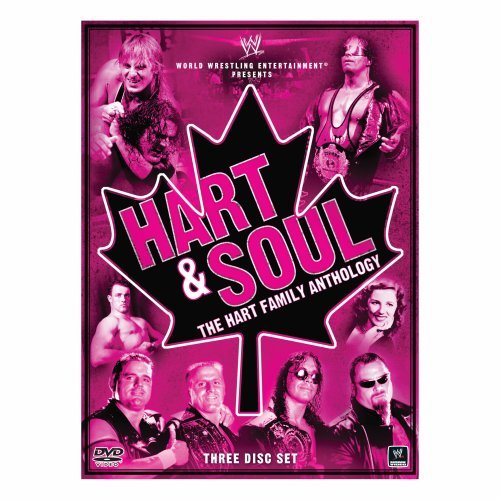
 (Although it’s not on the list, it is still a worthy purchase. You can buy it here.)
As owners of the biggest wrestling library in the world, WWE utilizes their staggering amount of material to bring this entertainment to the homes of the fans.
Since my 14th birthday in 2003, I have collected a vast amount of WWE discs. Of course these range from pay-per-views to documentaries to straight-up match compilations. Not just WWE, but tons of DVD’s in general.
Now it’s time to see what is the best of the best.
As you may recall from part two of this countdown, it should have been a straight 10-1.
However the amount of detail I surmised out of most of those entries took me a week to compile and edit, therefore I knew I wanted to make the top three really special.
So here we are. Three to go, but it won’t be a “nugget” read. Rest assured, these three will undergo strenuous re-watches (mostly on the special features to get caught up), and are DVD’s that must be in every wrestling fan’s house(s).
Without further ado, let’s jump straight into #3...
3. The Rise and Fall of ECW

Year Released: 2004
# of Discs: 2
Run Time: 360 Minutes
MSRP: $29.95
Favorite Bonus Feature: The easter egg of Chris Jericho doing a Ron Simmons impression. I am dead serious.
The best DVD’s in any company are created by people who have a direct passion for their product, and are able to successfully translate it to an entertaining product worthy of several re-watches. It could also serve as a capsule of important historical events that could not be available otherwise.
Although WWE Home Video is the creator of the disc, that is pretty much the only aspect it had to do with it.
When it comes to “what to say” “what matches/promos to select”, etc., it was all Paul Heyman, the mastermind of the original ECW.
This is by far the longest documentary on the count-down (more on that in a jiffy), but it is also the only DVD on the countdown to earn a TV-MA rating for really bad language. I mean sure there is some bloody matches on TV-14 material, but I’m serious when there are normally bleep-able swears on nearly every chapter of this documentary.
Looking at the insert, I counted FIFTY FOUR CHAPTERS for the documentary. Keep in mind they’re mostly 2-3 minute snippets, but DAMN! It was a whole page, whereas most documentaries only have like half a page for chapters. The next page would be all the extras (not including easter eggs of course), and it rounds out with a nice little collage of “extreme” imagery.
Speaking of the TV-MA rating, the last screen that pops up before the main menu has one of those warnings that since the program has indecent content, it is not suitable for children. I believe only “Bloodsport : ECW's Most Violent Matches” would have this disclaimer in addition, and that one was definitely worthwhile.

“Rise” starts out with the fledgling “Eastern Championship Wrestling” suddenly becoming the most violent promotion in the NWA (when it still had name power). After a over-throw of power and distancing itself from the parent organization (thanks to big part of a Shane Douglas promo that tells everyone to kiss his ass), ‘Eastern’ became ‘Extreme’.
With this “Extreme” revolution, new stars had to come to the forefront. Paul Heyman was smart enough to snap up guys that WWE and WCW would normally never give a second glance to. Names like Taz, Public Enemy (Johnny Grunge and Rocco Rock), Sabu, amongst others. Violent yet creative matches gave ECW some name recognition, but still the promotion was small and limited to where it ran (mainly the “bingo hall” in Philadelphia).
In the 1994-1995 time period, the company would rapidly expand. Simultaneously travelling up the East Coast while signing bigger names like Cactus Jack made a splash, newer-found talent like Sandman and Tommy Dreamer left very noticeable impressions on the fans.
The Sandman/Dreamer feud was especially chaotic, seeing as Dreamer hit the beer guzzler in the eye with a Singapore Cane. Sandman, who had followed his character to such a degree never left his house, returned to give Dreamer what was coming to him. Dreamer was a bad guy at the time, but getting his ass kicked regularly coupled with a hot Raven feud, would turn Dreamer face pretty much permanently.
Another way ECW made itself different from the “competition” was its vast use of technical/luchadore wrestlers. Not only did ECW have the blood and guts, but could back it up with straight-up wrestling that made fans cheer as hard, if not harder, than the usual fare. Sadly though, WCW would sign a lot of these guys (like Chris Benoit, Rey Mysterio, Eddie Guerrero, etc.) to lucrative contracts, and Paul would drag the company to court over “stealing talent”.
Eric Bischoff defends himself on the DVD, and in a sense, I agree with him. Scouts scoured for the men, they signed them to fruitful contracts, and made a living. Keep in in mind A LOT of ECW talent worked on either hand-shake agreements or verbal contracts, which could amount to “any-time” releases. Paul called Eric’s situation handling “a bunch of shit”, but at the end of the day, Eric did what he had to do in order to keep WCW hot in the Monday Night War.
ECW, though it was somewhat reeling in the wake of lost men, didn’t lose much momentum at all. While men like Tazz were sidelined from wrestling due to injury (broken freakin’ neck), other newly-discovered talents started to hone their future crafts. Like Steve Austin!
Austin, who had been in WCW, was buried, jobbed, injured, and released in that order. Apparently Hogan wasn’t “his buddy”. So Austin, while sitting on the couch in Texas, was invited by Heyman to go to ECW and talk his problems out on television. Some of the segments that followed, like “Steve-a-Mania” and “Monday Night Nyquil”, were some of the most infamous pieces of business cut in the organization. Austin would leave the company in very early 1996, but the point here was that the character that would evolve into 3:16, made his birth in ECW like Hogan’s character did in AWA before going to WWE.
Amidst controversial storylines (like Sandman’s family going with Raven, and even the Blue World Order comedy sketches), ECW was running like a train without a track. A train that very nearly got derailed in 1996 for two reasons.
Reason number one would be a certain crucifixion angle. The aforementioned Raven/Sandman angle got so hot that apparently Raven and his cronies tied up Sandman on a cross. Even Stevie Richards noticed that this was f***ed up. Another man who thought this was screwed up was Kurt Angle, who had made an appearance in Philly that night after winning in the Olympics. Kurt told Paul that if his face was associated with that program, Paul would be hearing from his lawyer. In addition, the fans were offended, and Raven made the standard “politician’s apology” out of character after the show.
Reason number two would be that their inaugural pay-per-view was nearly lost on a massive accident. In a live event in November of 1996, a scheduled talent wasn’t able to make the show. In his place was a young kid who falsified his information, and had a bus driver gimmick ala Ralph Kramden from ‘The Honeymooners’. Now let’s introduce another man into the mix by the name of New Jack. This guy is a legitimately dangerous motherf***er who was a bounty hunter with kills to his name. During this tag match, New Jack is thinking of how to bust this kid open since a toaster and a chair couldn’t do it. Jack busted the young kid up so bad that the ring quickly became a large red dot. This scared PPV providers so bad they didn’t want ECW to be aired at all! So fans wrote and called and pleaded for the promotion to get their show.
Fortunately, it worked. In March of 1997, ECW was finally able to broadcast “Barely Legal” live over the airwaves. Matches included Lance Storm vs. Rob Van Dam (sub. for Chris Candido), an international six-man tag, Sabu vs. Tazz in a grudge match, and a #1 contender’s match with Sandman/Stevie Richards/Terry Funk in a three way dance. Terry, who was almost 53 at the time, won the thrilling match, but only to see ECW Champion Raven come down to start the main event title match. Bloodied, battered, and hurt, Terry would summon all guts and courage to roll up the evil bird to win the big one! It was a highly emotional moment for everyone in ECW as they thought they couldn’t do it, but they did. In an amusing aside, the building couldn’t hold the power generated for the PPV broadcast, so about ten seconds after the sign-off for the show was done, the building went BLACK! Thankfully, ECW didn’t emulate WWE’s “Beware of Dog” debacle from the year before.
Vince defeated the government, God, but not Mother Nature!
ECW would experience another shaky moment after Raven signed a contract with WCW. The only thing this would do for the promotion is that Tommy Dreamer, who had been the perennial nemesis for Raven, finally got his win against the evildoer. Raven then leaves, and Jerry Lawler “enters”.
Lawler has been a commentator for WWE while wrestling pseudo part-time. When McMahon lent out his hand to cross-promote the small-time company, Lawler went on a in-character tirade over how ECW should be begging and pleading for their lives with WWE giving up precious on-time screen to promote them. This led to some heat-filled moments in ECW land. One of them led to Lawler caning Tommy Dreamer in the testicles so hard that Dreamer went to the hospital and had TWO CC’s of fluid drawn out of his balls. Yep, you read that right. Lawler wouldn’t be in the promotion long.
A particularly interesting chapter revolved around Tod Gordon’s departure from the company. From what was understood, it was as if Tod could have been a “mole” for ECW, i.e: scouting talent for the big leagues. Paul accepted the letter of resignation with sorrow, and in my mind, started the downfall of ECW.
Paul Heyman was such a genius when it came to booking his material that WCW and WWE eventually started to “steal” the hardcore gimmicks. An AWESOME video package highlighted this, topped with Foley being thrown off the Cell and Triple H giving a Pedigree to Cactus Jack on thumbtacks.
While that is the case, Heyman was not in the know on the term “don’t write checks you can’t cash”. On the tail-end of the promotion, many wrestlers weren’t paid at all, and were basically starving trying to “make it”. This makes Bubba Ray Dudley’s comment on ECW somehow almost being #2 in 1998 really ridiculous.
ECW also failed in one other area: proper TV promotion. Sure there was the contract for TNN, but that network was sabotaging the company before the air episode aired. To their “standards”, this promotion was “extremely crappy” (my words not theirs). The cameras were subpar, there was too much “hate”, and to top it off, the WHOLE CARD of the first episode was scrapped because the network didn’t like their material. So a Rob Van Dam/Jerry Lynn match from an earlier event pretty much filled up that hour, which left either a bad impression or a good impression on the fan watching at home.
ECW would make their ‘Cyrus’ character a knock at the network, which sadly became one of the more over characters by the end.
The end of the promotion was inevitable, but sad nonetheless. Paul Heyman wasn’t even present for the last event “Guilty as Charged” in 2001 as he was trying to “secure another television contract”. If anything, Rob Van Dam was present to do the last match on the card despite being owned a shit-ton of money.
Dawn Marie said it best, “You have to appreciate what you have today because it may not be here tomorrow.” For as slutty as her TV characters are, that woman said probably the most truthful quote out of almost all DVD’s made.
So while some things were skimmed over (like the departures of Tazz/Dudley Boyz plus Mike Awesome defecting to WCW as champion), the main “story” if you will was outlined. In a nutshell, it was three hours of a promotion’s tale told by people who lived it and compiled by people who cared.
There were no special features on disc one, so all of them were relegated to disc two. In told, there were seven matches, a few interview spots, and a few easter eggs (like Y2J’s impression of Ron Simmons).
I know not everyone can find EE’s, so here’s a freebie. Enjoy!
The matches weren’t exactly the greatest you’ve ever seen out of the promotion, but for extras they’re decent. For example, the Dog Collar match between The Pitbulls and Stevie Richards/Raven is a brutal contest that showed the heart of all four men. RVD/Lynn from Hardcore Heaven 1999 is an exemplary match of their rivalry, complete with RVD showing (I believe in a easter egg) how he got a scar on his face from the bout. Of all bumps on this disc, by far the most memorable one was when Bam Bam Bigelow drove Tazz through the mat at Living Dangerously 1998. Another easter egg showed the Public Enemy training Mikey Whipwreck for his Ladder Match with Sandman.
This is going to sound crazy, but if WWE released a one-disc only version, it would probably sell like hotcakes. While the extras feel absolutely secondary, the main course is more legendary than something Neil Patrick Harris conjures up. It’s a three hour emotional tour de force of a promotion that was given care, and the evidence shows. Essentially, you’re not a wrestling fan if you don’t have this.
2. The Shawn Michaels Story - Heartbreak & Triumph

Year Released: 2007
# of Discs: 3
Run Time: 540 Minutes
MSRP: $34.95
Favorite Bonus Feature: Of the non-match features, most likely the Brown Pants story of how Shawn Michaels had botched pants going into Survivor Series 2002. For the matches, my heart tells me to go with the match from Vengeance 2005, but my head tells me to go with the Triple H match from 2003. Whatever you choose, you can’t lose!
Shawn Michaels, as you could probably tell, is my #1 biggest influence in wrestling. His demeanor and craft in the ring are absolutely un-paralleled, and in this life-time, there will be no one like him.
So with a set like this sure to rank #1, why the hell did he lose? Well, I wouldn’t call it losing, especially since it’s amongst the most re-watchable DVD’s I own.
When I did this overall review of the discs I have, I had to think of the total package. DVD’s like Wrestlemania X-Seven have an excellent main course, but little in the way of significant bonus material. Other discs like Bad Blood 2003 have an ATROCIOUS main attraction, but the extras are surprisingly grand.
For this collection, and the one that beat this out, they’re both similar. 3-disc sets. 2+ hour documentaries, lots of great matches, and deleted scenes of fun anecdotes that quite frankly should have been in the main show.
So again, why the hell did this lose?
Essentially one reason and it would be that the match selection is only on the “better than average” side. What I’m really saying is that the MULTIPLE compilations that Shawn Michaels has had actually was a dent against it, as a lot of really good matches seeped onto those. Keep in mind a lot of these matches on this collection are better on their worst days than most wrestlers on their BEST days. Unlike a certain ‘Hitman’ set that felt comprehensive on its lot, this one felt like taking a good match from all eras while not truly representing them all. Long story short: this feels like a great starting point, and all the other sets (like From the Vault and My Journey) are companion pieces to make a giant whole.
With this entry, I’m trying something a little bit different. I have retrieved the chapter list from Silvervision, and I will be doing a short summary on each to get the overall narration down. The main meat of this three-disc collection, a 2 hour+ documentary, focuses on Shawn’s life, from the highs (almost literally) to the lows (as in Rock Bottom, no Dwayne Johnson reference implied). As usual, extras will be somewhat bunched together in review, so here it is, the second best DVD on the countdown!
Growing Up: Covers essentially the first couple of decades of his life. Born to a military family (and therefore had no stable hometown for a while), Michael Sean Hickenbottom was an athletic young boy. Football star in the youth, he would eventually getting the wrestling bug by doing what most young fans do: watch the shows on TV then in the arena. Also practicing at school never hurts too, as Shawn on location at his old high school shows the dents the walls STILL have doing moves in the hallway!
Learning the Ropes: Via agreement with his father on keeping his grades “up”, the young Hickenbottom was able to enlist in a wrestling school run by super sock Jose Lothario. This would lead to the young boy’s first match which caught many a wrestler/promoter by surprise. When WWE does the “Don’t Try This at Home” promos, remember that Shawn is the exception not the rule. While he would be a jobber for a little bit, Shawn would become wiser in the ring, and in no time, was calling the matches himself!
Midnight Rockers: After being partnered up with Marty Jannetty, Shawn would travel up to Minnesota to be part of the AWA promotion. As The Rockers, these two would regularly steal the show with innovative tag team wrestling and maneuvers. Before going to WWE in the next chapter, they would win the tag titles in a nearly year-long feud with Playboy Buddy Rose and Doug Summers.
Just a taste of what was to come.
Big Break and Downfall: NEW YORK NEW YORK! new york new york. They got the call to go up North to the WWE, and work their first show. Only they “broke a rule” on their first night. The anecdote goes how Marty and Shawn were sitting at a table next to Jimmy Jack Funk (aka the only faux Funk), and Jimmy dared them to break bottles over their heads. So they did, “caused property damage” in an exaggerated story, and were fired. After starting all over, it took about a year to return to the WWE.
Second Chance: Shawn and Marty made the most of their rebirth in WWE. Not only did they still steal the show, but with more experienced teams (like The Brainbusters, Arn Anderson and Tully Blanchard), became even better. Their lone tag title win/strip was covered here, and is also on the DVD as a disc two extra. Long story short, the match was trash and Vince couldn’t allow the team to win the esteemed titles on such a shoddy build. It would about another year in tag team purgatory before a major chance of pace was about to be endured.
Heartbreak Kid: We all know the story. Shawn kicked Marty in the face, then threw him through the ‘Barbershop’ glass. Add in Sensational Sherri, Curt Hennig’s fast wit, and a brand new attire, it equals HBK. Some of single Shawn’s early triumphs are mentioned, like his first Intercontinental Championship win from British Bulldog at Saturday Night’s Main Event.
Diesel: After the on-air break-up of Sherri and Shawn, it seemed like HBK needed a new bodyguard. While having a day off, Michaels watched some WCW and stumbled upon Vinnie Vegas. Thinking he’d be perfect for the new bodyguard, Shawn got some connections together to get the man behind the ego, Kevin Nash, to WWE. Nash would become not only an on-air ally, but an off-air one as well.
Suspension: Shawn had some really good matches with the IC Championship, but a failed drug test showed he may have used steroids. Shawn, outraged at the claims, never bothered to return the title belt. Vince McMahon was FURIOUS at the decision, but decided to make money with it instead.
The Ladder Match: This was when Vince was thinking of business instead of employee behavior. Wrestlemania X (1994), the Ladder Match. Revered and respected by everyone, it put Shawn on the map as “The Showstopper”.
Clique: Shawn had a small group of buddies whose political nature was either greater than one realized or was exaggerated way out of proportion. In addition to Diesel, Shawn would have Scott Hall (Razor Ramon), Sean Waltman (at the time 1-2-3 Kid), and then Triple H.
Friends Fight for the Title: Basically a synopsis of Wrestlemania XI Not released on any DVD compilation besides the WM Anthology, so here ya go!
Knocked Out: This was the time where Shawn was attacked by Marines in the latter half of 1995. What it led to was Michaels dropping the Intercontinental Championship (which he won from Jeff Jarrett as an extra match on disc three), and started a miraculous run towards the WWE Championship. It should also be noted that for a planned angle (of being knocked out), there was A LOT of legitimate outpouring to Shawn at the hospital where he was “staying”. For the hell of it, here’s a rare extra!
Boyhood Dream: After winning the 1996 Royal Rumble, it was the Road to Wrestlemania. To put this into better perspective, go back to the “From the Vault” DVD and watch the match and special features.
Curtain Call: What you learned from the internet is all you need to know about the controversy. Mainly it covered the topic as something that was blasphemic, but also at the same time, something that was important to Shawn, Hunter, Kevin, and Scott.
A Champion’s Struggles: Shawn Michaels as champion on paper sounded really good. Unfortunately, it was definitely not a smash success. While he was putting on clinics in the ring, he was also putting clinics on primadonna behavior. Being WWE Champion in a nutshell was a nightmare, especially since WCW was on the upswing.
Hometown Hero: After losing the title at Survivor Series in 1996, Shawn went back to his hometown in San Antonio as #1 contender and home-town boy. Overcoming the flu with 60+ thousand fans, Shawn was able to regain the title at the Royal Rumble.
“I Lost My Smile”: The promo is on the From the Vault DVD if you were wondering (in an Easter Egg). Long story short: it covered Shawn’s “injury” then forfeiture of WWE Championship. It would only be a few months before Shawn returned, and lit the world on fire again. The “return” on the DVD was explained via a still graphic.

Hell in a Cell: In simple terms, talks about the match with Undertaker from In Your House: Badd Blood.
De-Generation X: Mixing real-life backstage antics with on-screen character, Shawn rangled up buddy Triple H and H’s manager Chyna, added in Rick Rude as a “insurance policy”, and hell in the WWE was re-defined. The transition of “regular HBK” to “D-X HBK” was awesomely done in the editing to the video piece.
Montreal: Do yourself a favor. Buy the new Greatest Rivalries DVD, okay? It is by far the best explanation of the matter with both sides present.
Rock Bottom: This is a real bummer of a chapter that covers about four years of life. This is also the longest chapter on the DVD. So Shawn Michaels injured his back at the 1998 Royal Rumble, and while he was able to “do the honors” at Wrestlemania, his in-ring career as he knew it was done. Instead of living off the fruits of his labor, he went from pill-popper to completely dependent on drugs. This also includes the marriage to Whisper (Rebecca), and the birth of his son Cameron. One sad tale of cookies starts what would be the re-genesis of HBK.
Faith: A glorious beginning to the chapter showed HBK at his local church with light shining down on him. After agreeing to be re-born, the effects of this change are wonderfully dramatic. Kicking pills and booze out, Shawn became a re-focused family man with a new zeal of religion and life. This is seriously the complete extreme of the last chapter, and will bring a smile to your face.
Return: In Shawn’s autobiography, it was noted how this should have been a match with Vince McMahon in a one-off Street Fight at Summerslam (in 2002). Substitute Triple H, and the fact he could “still go”, and ladies and gentlemen: SHAWN MICHAELS IS BACK!
Fan vs. Idol: This touches on the Shawn Michaels and Chris Jericho feud from latter 2002 to mid 2003. “It’s like Memorex,” was commented by Jerry Lawler (in archival footage) and Kerwin Silfes (in interview). A fantastic match all the way around.
Brother, Brother, Brother: This touches upon the Hulk Hogan feud from summer 2005. Apparently it was just a way to say how Shawn was professional while Hulk wasn’t, and once again, Hulk had things his way.
No Holds Barred Against the Boss: The feud from later-2005 through much of 2006 is covered. Starting with references to the Screwjob, then elevating to the match at ‘Mania. If you’re going to beat up your boss, you better do it well!
DX- Reunion: At this point, Hunter and Shawn had a on-and-off rivalry that lasted four years. A simple kick to the face of a cheerleader turned that around into a long-standing on-screen friendship that resulted in the return of WWE’s most celebrated faction/duo. While Shawn was a little apprehensive about the material (due to being the family man/church man), it was still fun watching these two doing their schtick in the only way they know how.
… Still the Main Event: Even in his forties, Shawn main-events Wrestlemania. This time against John Cena, the “Superman” WWE Champion. While Shawn lost (via submission), just the fact that he led the champ through a great match is vindication alone of a great career. At this point, people just rave about Shawn’s abilities and success, seeing as the high road is just getting higher.
The Best Ever?: The usual “ending” chapter, it summarizes the documentary/career of HBK. With WWE’s know-how of camera angles and video editing, Shawn’s stature beacons like a wrestling God-figure.
Disc one’s special features are mainly deleted scenes (like Shawn’s ill-fated Wrestling Academy),promos (like the Larry King spoof in the Hogan angle), and personal anecdotes filmed completely to the side of the main feature. Among these are the “Brown Pants” and the story of how Shawn had to cope using a 20 foot ladder against Vince McMahon at ‘Mania.
Discs two and three are matches only. Two has mainly tag team attractions fitting to his later 80s and early 90s career. Three has mainly matches featuring Shawn at his best, while having a fun little side-match with the reuniting of Marty Jannetty as the Rockers.
Speaking of them Rockers, that’s almost all disc two. The first match is a jobber squash as young Shawn takes on monster Billy Jack Haynes. The next five matches are all Rockers, and good ones to boot. All these are exclusive to the set to the best of my knowledge, save the Orient Express contest (which is also on the Royal Rumble Anthology). In particular, the Brainbusters match is AWESOME, seeing as two great teams with nicely-contrasted chemistries finally get to clash. Also, the “ropes breaking” SNME match with the Hart Foundation is here. RETROACTIVE DRINKING GAME! The British Bulldog match from SNME is on here, just like part one of this collection and the Best of SNME. You better drink! Of course we have the 1995 Rumble to conclude the disc, which actually was pretty crappy seeing as it was mostly jobbers. Shawn’s “near-elimination” is neat though.
Disc three is all solo matches (save for the “reunion”). Starting off the with Jeff Jarrett IC title IYH encounter. Nice match, it’s fast-paced and shows both men working their asses off. Shawn gets his third IC title on/near his 30th birthday. King of the Ring 1996 sees Shawn defend the title against British Bulldog as a re-match from the ill-fated Beware of Dog match. To be honest, I thought the post-match angle was much more interesting than the match itself. At some 26 minutes, it felt pretty long at points. Next up is a HUGE gap to December 2003 where a newly-healed Triple H takes on Shawn in San Antonio. Cue the home-town screwjob! Shawn “pins” Hunter, but BOTH elbows are on the mat! After Shawn has a hissy “fit”, Eric “fires” him. Although their Wrestlemania 21 match is more well-known, the Vengeance rematch is no slouch. Against Kurt Angle, Shawn’s physical selling and pace really added to this equation. Unlike a submission loss in the last encounter, Shawn superkicks Kurt in MID-AIR to secure the duke. Finally, there’s the epic non-title re-match with John Cena in England on RAW. Because of “technical difficulties” (i.e: Randy Orton threw a lamp in a hotel room), John and Shawn were asked to do an hour. So they did. It was pretty fast-paced despite the fact Shawn’s in his forties and Cena hasn’t had a match this long before. Shawn gets the win with a Sweet Chin Music, and holds the title high in the air afterwards signaling a “I’m gonna get this” for Backlash the couple weeks after.
In summary, there is no real gentile way of wrapping up this DVD. It is full of climaxes, denouements, but more importantly, it’s a story about a man whose faith got rewarded into an improbable second career. The extras are a nice aside to one of the better documentaries in the WWE cannon, and it’s easily one to keep on the shelf.
____________________________________________
Speaking of the shelf, there is one more to put on the list. One more that speaks the embodiment of why DVDs are made. One more that has an all-around package so devastating in it’s punch, so versatile in its moveset, yet it is never assuming and never casts a shadow over its ego. A DVD that sounded impossible in the time it was created, that alone deserves #1. However, it’s the real deal that stands in a class by itself. Ladies and gentlemen, I bring you NUMBER ONE!...
1. Bret "Hitman" Hart: The Best There Is, The Best There Was, The Best There Ever Will Be

Year Released: 2005
# of Discs: 3
Run Time: 540 Minutes
MSRP: $34.95
Favorite Bonus Feature: This is a first on this countdown. I am going to make ALL of them winners. The stories. The matches. EVERYTHING. I looked at the list and I’m like, “Oh crap, I gotta choose?” I’m not going to choose.

Even eight years later, Bret “Hitman” Hart still had a beef with Vince McMahon over the Montreal Screwjob. So that in one respect is incredible, but this is the culmination of what Vince said was “big” of Bret to do.
No seriously, the opening little ditty before the main program shows Vince McMahon acknowledging Hart for not only contribution, but being able to put aside professional/personal feelings in order to tell this tale. Some may call it silly, I call it giving due to where it’s due.
I should also note before the main menus are TERRIFIC. It’s a simple background with a video of Bret highlights interspersed to his music, but it’s all epic! That alone should tell you it’s “gonna be good”.
Now like the last entry, I’m going to break the summary of the documentary (which is some 5+ minutes longer than Shawn’s) into the chapters. There are sixteen chapters to the thing which means there is a lot of meat on the bones, so some of these may be wordy.
Early Years: It seems like a story we all know. Stu Hart emigrates from England to Ellis Island, moves to Canada, marries Helen, and has TWELVE children. Genetically, next-to-youngest boy Bret becomes a wrestler, one that is poised to take on the world. Bret credits two Japanese wrestlers to helping him train for the big time, and owes everything he has to them. The singular best anecdote of this chapter revolves around Bret going to Puerto Rico basically on a technicality (he is a “B. Hart”), and therefore learns the craft more.
Stampede Wrestling: From the beaches of Puerto Rico, Bret decides to make a go at going pro full time. While Bret understands he is Stu’s boy, he also understands he doesn’t want to piggy-back off his father’s success, and wants to relay what he learned into becoming his own entity. First feud covered seems to be the British Commonwealth Junior Heavyweight Championship with Dynamite Kid (Tom Billington). They had (or least that is what seems to be conveyed here) a great series of innovative matches, which Bret explains is due to both of them imagining spots in their heads. Yes kids, one of the images shows a suplex over the top rope leading to the ring bell, because in olden days, over the top rope maneuvers were banned pretty much everywhere! Next up is the International Tag Team Championship, with Bret tagging with brother Keith in this segment. Admittedly, Bret explains being tag champions as “mathematics”, that since there was no else to wave the flag, the was plugged in. Lots of archival footage for everyone to enjoy here! Next up is North American Heavyweight Championship, as Bret says he wanted to drop the tags and move up a weight class. Again, more archival footage of Bret whopping ass while getting his ass whipped! Receiving this title belt, while again it was “mathematics”, it was also attributed to the prior champion Leo Burke, who gave Bret a big rub in the process. After that match, the feud with David Schultz is featured. And following that is NICK BOCKWINKEL, perennial bad-guy champion. In one of the first times ever, a feud with Bad News Allen resulted in a Ladder Match as #1 contender for the NAHWC. Next up is The Stomper, with a Lumberjack stipulation added into that one. After a bloody contest, where Bret was disadvantaged, the next encounter would be an even bloodier Chain affair. Stu Hart helps Bret while Stomper’s manager JR Foley (no, not the love child of Jim Ross and Mick Foley) runs amok. This leads to the predictable tag match, and little bit of warning: Stu at his age should never have taken his shirt off. Bret comments on how the most important thing as champion is to be the guy who deserves to be in the main event, that people believe you. The chapter concludes with Bret’s trips to Japan.
Coming to WWE: As the story goes, WWE was into the global/territorial expansion phase at this point. Brett (as in that’s how his name was first spelled in the promotion) was a focal point, as well as the team that would become the British Bulldogs (Davey Boy Smith and Tom Billington). Early on, Bret was nothing more than a jobber with skills! A jobber that also didn’t have a great physique or can cut a promo worth a damn. Hell, they tried to make him a COWBOY! The less said the better. In a transition piece, Bret called George Scott (who pitched the idea), and told him that where he came from, he’d better be a REAL cowboy in order to impersonate one. As a counter-act...
Hart Foundation: ... Bret told George he wanted to tag with Neidhart. Only problem is that George told Bret he was “too soft” to be a heel (as in he wasn’t convincing). Bret was ready to quit until George told him the good news: he’s turning heel, and being partnered up with Neidhart. One of the reasons why Bret was so enamored with this change is that now he can call the shots as a heel, and throw his good guy opponents “bones” (or opportunities to look good). Finally, a ring general in the making. As a team, the Foundation (with Jimmy Hart as a manager) was one of the most well-rounded teams out there. Bret was the smaller and more well-rounded wrestler while Jim was the bulldozer that could crush and destroy on a moment’s notice. It would also be noted that Jim was be the primary promo man, while Bret’s strength would be the matches. Their contests with the British Bulldogs were innovative not only in their moves, but also the fact that all four knew each other from the Stampede territory in Canada. Another strength was elevating their opponents’ games, whether as a heel with the Bulldogs or as a face with Demolition. Another awesome video package on the way! Showing their initial title win back in 1987, it proved that the Foundation was the best team in the ‘E. Originally a “throw-together” team, they evolved into something bigger. That’s why you never turn your back on a new team on the scene!
Intercontinental Champion: While Bret was never stagnant in his team with Neidhart, he knew that if he was going to be the best, he would need to branch out as a singles star. Bret was on the notion that while he was tagging, people who were “less” than him (I.e: Warrior) got breaks. Time to get “a piece of the pie” (yes, read that like The Jeffersons). Summerslam 1991, Intercontinental Championship against Curt Henning. Legend goes, and it is confirmed not directly, that Curt would only drop the belt to Bret. Only because though Curt had a bad back, definitely not “Perfect”. So Perfect, w/ “Coach” John Tolos in his corner, is set to take on Bret on what should have been Henning’s last match ever. Yes, this match is an extra. Even in the doc, just listen to that pop after Bret kicks out of the Perfect-plex! Bret does get a little emotional about the lengths Curt went to in order to make the next IC champ look good. Wrestlemania VIII is up next, with Roddy Piper as champ heading into it. Now to anyone who doesn’t know the story, here it is. Bret lost the IC title the night (or week, don’t remember which) before against The Mountie. Piper, who had been nothing more than a commentator at this point, returned to action to face Mountie, and win his first (and only) singles title in the WWE. So Bret’s rematch came against Roddy. Bret, a bloodied mess (thanks in part to a slick blade job that looked like a real accident), won the title back. Bret convinced Vince McMahon to wrestle Davey Boy at Wembley Stadium (in England) at Summerslam with the IC Championship on the line, with Vince putting this match LAST. No problem (even if Davey wrestled the match high as a kite). Disc two extra here kids. It was unique bringing this angle to a head, because of the fact that Bulldog was married to Bret’s sister Diana, and that Bulldog’s career has been aided by Bret. While doing some risky spots (like a completely blown dive spot), Bulldog won the title, and Bret’s stock in the company rose meteorically.
WWE Champion: After losing the IC belt, Bret decided to pursue the big gold belt of prestige. In a match at Saskatoon (in Canada), Bret took on Ric Flair for the title. Let’s not forget that Flair is legitimately injured at this point (he had that ear problem), and therefore had to lose the belt quickly. That’s not covered here, but I will do the honors. Bret does put Flair over on the match, saying he’s in great shape and a phenomenal performer. A weird injury occurred as Bret dislocated a finger after being shoved off a Sharpshooter attempt. It all worked out fine as Bret won via submission and now is a WWE Champion. In a very difficult time for the business, Bret sold his stock as a wrestling champion instead of a hulking behemoth (like, well, Hulk). Not only was Bret improving as champion, but had a growing fan base as well. Also in a drastic change of pace, Hart didn’t have his own dressing room, instead opting to change with the boys because he was always one of them. In a hard twist of fate, just when he thought he was the star, the “old star” came back to steal his prize away. After Yokozuna won the WWE Championship from Hart at Wrestlemania, Hulk Hogan challenged Yoko on the spot and won the belt! Although not directly linked to the title, the 1993 King of the Ring was pretty much a Bret Hart Tribute Show. Over the course of the night, an 8-man elimination tournament showcased the best in the federation going at it. Hart defeated Razor Ramon first (in a rematch of the Royal Rumble title encounter), then Mr. Perfect (in a face vs. face rematch of Summerslam 1991), and finally bested Bam Bam Bigelow in the finals. It was a wonderful showcase for Bret as he had three different battles with three different guys, yet they were all good matches. Although WWE tried to build up Lex Luger as the next big thing, the company knew it wasn’t going to work, and at Wrestlemania X, the belt was Hart’s again after beating Yokozuna in irony. Finishing up the chapter, Bret describes wrestling people of different sizes, shapes, and strengths. To quote Ric Flair, “To beat the man you gotta beat the man. WOO!”
International Star: Fans love Bret Hart. It doesn’t matter if you’re in the United States, Canada, England, or even in the poorest parts of Africa. For example, Bret made a point about no matter how tired he was in Germany, he’d always come out to the lobby of the hotel and sign autographs for people to show he always cared about them. Jim Ross counts Bret’s titles down and then realizes he was the man! Vince also states that the skills/storytelling ability he had are only matched by Buddy Rogers from the 50s, and for those who don’t know who he is, that man is the first ever WWE Champion. Technical ability and his straight-laced attitude were two of the reasons why he was worldwide in his appeal.
Hart Family Feud: Although it’s not mentioned, it should be noted the on-screen jealousy Owen possessed for Bret started at the 1993 Survivor Series, when Owen of the five Hart brothers was the only one eliminated from the tag match. Now the real turn sprung at the Royal Rumble in the tag title match, when Owen jumped Bret post-match and kicked the leg out of his leg.
Owen was originally thinking about quitting the wrestling business altogether to become a fireman in his native Calgary. Thankfully, this angle with Bret was more than enough to convince him not to. The angle was so emotional, it brought upon real feelings and reactions from fans worldwide. This contest is indeed an extra on the DVD, so I will say this: the finish is an incredible rub on Owen, and will only get better as Summerslam rolled around the cage. Ironically, the storyline only made the brothers Hart closer. In a aside, Bret noted that most cage matches are bloody, yet the style they fought was unique and could truly be pulled off by very few people. In a very touching conclusion to the chapter, Bret noted how he guided Owen to the fall (aka Superplex off the top), and with how his life ended, he felt good knowing how professional they were.
Iron Man Match: While this story is told from Bret’s POV (like the hobbling 40 year old on ice versus Shawn beating up jobbers), the best way to view this angle is on the From the Vault DVD. And the Greatest Rivalries disc. It’s pretty much everything we knew before about how Bret, in his third title reign, was pretty much keeping the belt warm for Shawn Michaels for Wrestlemania XII. Bret does put over Shawn in this chapter, and the punishment they both endured.
Stone Cold Steve Austin: Bret has his sabbatical from the end of Wrestlemania XII all the way to November. During that time he healed up and even did a “Lonesome Dove” show. However, he wasn’t completely absent from WWE. One superstar in particular made sure of this, and that was Stone Cold Steve Austin. Hart had watched Austin ever since he his WCW days, and pinpointed him as a man he could work a match with. Turn match into huge angle and we got $. Stone Cold was getting a long and continuous rub ever since King of the Ring, but Bret’s know-how really put him over the top. Pink font on black background? What a load of crap!
USA vs. Canada: Bret turned from a good man to a bad man. However, it was a very layered bad man. Bret blamed his misfortunes on American fans, who have no rules and morals. In addition to being able to set his brother Owen and brother-in-law Davey Boy Smith straight, Bret was also able to give a re-birth to the Hart Foundation. Not just some rip-off of the original. No, if anything, it felt like the original but with more bad-ass people to supplement the message. Bret, Owen, Davey, with Jim and Brian Pillman in the wings, spreading hate about America and destroying whoever gets in their way. Steve Austin and Shawn Michaels added more layers to the feud as two men who couldn’t stand each other yet were able to fight the good fight against these evil-doers. Let’s also add a worldly element to it, as Bret and his cronies were hated in America, but once they crossed that border to Canada, they were like the second coming. It was a fun time for fans, the wrestlers, but more importantly, made for great TV (which was sadly second fiddle to reran “new” episodes of WCW Monday Night Nitro).
Survivor Series 1997: I’m only going to say this one more time. Go buy the Greatest Rivalries DVD. If you want to go one step further, try Hitman Hart: Wrestling With Shadows - 10th Anniversary Collector's Edition .
WCW: Much about been talked about how the management in this organization was shoddy on their best day. However, no one truly realized how bad it was until it was too late. Bret Hart was one of those examples of how to completely screw up a hype appearance. Gee, make a fake screwjob at Starrcade just so Bret can “reverse” it? Ugh. Make it so the most over Bret can be is when wearing a steel plate under a jersey? Jesus jumping jacks, when could anyone get anything right? The main point expressed is that Bret REALLY regretted leaving WWE. It was as if Bret went from being the best marketed man in wrestling history to being a pile of shit in a wagon. The pile of shit in the wagon that is is that he wasn’t in “the know” with upper WCW management, and thus was promptly ignored. Bret had a great match with Chris Benoit on Nitro, which is indeed a great extra although now soured by recent events.
The Death of Owen Hart: Appropriately enough, they start this chapter with the image of JR and King at the desk from Over the Edge 1999 when they announced how Owen was planned to do an aerial entrance, but a horrible accident happened, and that he died. While JR had the worst responsibility in the world to announce it, King’s face really told the scenario. Bret has always regretted not being in the WWE when Owen had the accident because Owen had been so good to him, he wished like he could protect his younger brother like an older brother should. In one of the tributes on the RAW after Owen’s passing, Jeff Jarrett’s was disturbing to watch, mainly because of the genuine pain expressed through his face and dialogue. Bret’s WCW promo really struck some chords, as his chilling words will put anyone in tears. I know I mentioned the Benoit match before, but this was an anomaly in WCW history. A thirty minute TV match that thrilled the crowd, and felt fitting for a tribute match, if any such thing could exist. While this wasn’t talked about in the documentary, let me put one thing perfectly clear: this was an accident. A horrible, far-reaching, saddening, sickening, accident. The company that does the aerial harnesses for Sting’s WCW entrances were with WWE on this night. Owen had been really reluctant to do this stunt as the Blue Blazer, but his level of professionalism masked any insecurities he may have had. Essentially, he was a model employee who didn’t want to stir the shit. So practicing the entrance, one of the harnesses were released too early, and that sent Owen falling down to his death. This is one of those sad reminders that professional wrestling is not ballet, and will never be so. Accidents happen, and unfortunately, workers may die from it. No matter what they do, I will always respect wrestlers for putting their bodies on the line for the sake of entertainment and sportsmanship.
Problems in WCW: A continuation of the WCW chapter. It just drills home the fact he was badly misused. Sure Bret won the title, but at that point, it was like a big gold belt. A kick to the head at Starrcade 1999 from Goldberg gave Bret an injury so devastating, it started the rapid dissension of not only his career (which more concussion from Terry Funk matches would exasperate), but his health. Even Bret felt bad that of all people to end his career, it was kind-hearted Goldberg.
Living It Up: Bret suffered a stroke as a side effect of those concussions from 2000. This would give him a chance to reflect on his life, while trying to get his priorities. The final few minutes would wrap up Bret’s career in the usual nice comments from interviewees while having a great video package liven things up. With how well this particular movie did, I’m almost surprised WWE didn’t take “A King’s Speech” approach to how Bret had to re-learn to talk after a stroke, and had to learn to talk in time for his father’s funeral in 2003.
So disc one’s documentary is a long, thorough, and very documented account of Bret’s career, as told through a WWE lens. For a WWE documentary, I liked how it wasn’t re-written for revision purposes, and also like how Bret was able to start making/taking amends for past injustices in order to get the fans what they want.
That being said, let’s dive into the biggest dessert buffet this side of 8.5 gigabytes of dual layered goodness eh? It’s special feature time!
Disc one is full of bonus stories, and a couple of matches to boot. First off is a whole bunch of anecdotes, ranging from Owen Hart prank-calling Stu (which gets funnier every time I hear it) to how Bret and Jim got along like brothers in the Foundation. There is also a Dean Hart Tribute (Dean was the brother who passed due to kidney disease), and also a tribute for all of Bret’s colleagues who passed on by the time the disc collection was released. Add in two stellar matches with the Foundation vs. Killer Bees then the Bulldogs, and awesomeness just reeks out of this disc.
And to think more great material is on disc two. Nine matches. and all of them kick ass. Starting off with the Wembley match at Summerslam 1992, and the legend surrounding it from the DVD. Next up is a rarity, a match with Bam Bam Bigelow in 1993, in Spain, with Spanish commentary! That’s right, no English to be had! I know Bret hand-picked the matches, but damn, he needed to do commentary with JR! Both classic PPV encounters with Mr. Perfect (King of the Ring 1993 and Summerslam 1991) are here, and are glorious! Owen Hart makes his presence known with his win over the bigger brother at Wrestlemania X, still the best opener in Wrestlemania, hell, PPV history! Two house show matches with Ricky Steamboat in 1986 and Ted DiBiase in 1989 are up, and Bret in rare singles form works well against both! There’s a SNME match with The Rockers from April of 1990, which resulted in a double-DQ after Demolition ran in and squashed ‘em all like peas! Finally there’s the tag title match with the Nasty Boys from Wrestlemania VII, which truth be told, is a good match considering one team Sags and moves like Knobbs. Yeah, a horrible pun, but whatcha gonna do. I should add the commentary on the Steamboat match is beyond hilarious, and that alone is a ***** classic!
Disc three is the icing on the cake, and to think disc two is cake and ice cream! First up is a house show match for the WWE title in 1994 against Owen Hart in White Plains NY, which in seriousness is a short drive from where I live. A great match with Hakushi from In Your House in 1995 is next, which shouldn’t be a surprise, but considering Hakushi didn’t stay long, it’s a nice match to have. The Survivor Series 1995 title match is in the following, which I have covered before in a prior blog. Read on further, and guess what, Wrestlemania 13 shows up as well! 1995 isn’t done yet as a bloodbath with Davey Boy Smith is in the offing too! Add in a rarely-seen One Night Only match with Undertaker (which you can’t see on VHS), with the Benoit match from WCW, and that’s a wrap!
So why in the hell are you reading this? Go get this, pop it into your player, and WATCH THE DAMN THING! This is without hyperbole the greatest disc collection ever, and I don’t think anyone will ever top it. It’s one of those “magic” collections where it has everything you need with no wasted space and everything is of top-shelf quality.
IN CONCLUSION: WWE has the biggest wrestling library in the world. For more than a decade they have made it a service to release high-quality discs to fans of the universe to show history in shining glory. Hopefully over this epic three part harmony, I can prove that there is lots of quantitative greatness to be achieved. If you’re a collector wanting to start out, please read this. If you’re a person wanting the certain disc and needed recommendation, please read this as well. This is a culmination of personal/topical research that has resulted in a respectably large collection with lots of background info to be shared. I have no true ending for this, so I take a small bow.
____________________________________________
If you would like to read biographies/autobiographies on personalities covered, please help this blog and click/order on the links provided:
Mick Foley: Have A Nice Day: A Tale of Blood and Sweatsocks, Foley is Good: And the Real World is Faker Than Wrestling, The Hardcore Diaries, The Hardcore Diaries
Road Warriors: The Road Warriors: Danger, Death, and the Rush of Wrestling
Chris Jericho: A Lion's Tale: Around the World in Spandex, Undisputed: How to Become the World Champion in 1,372 Easy Steps
ECW: Hardcore History: The Extremely Unauthorized Story of ECW (Second Edition)
Shawn Michaels: Heartbreak & Triumph: The Shawn Michaels Story
Bret Hart: Hitman: My Real Life in the Cartoon World of Wrestling
____________________________________________
Disc One
Disc Two
Or just eject.
del.icio.us Tags:
wwe,
wwf,
wrestling,
blog,
bad booking,
wcw,
ecw. shawn michaels,
bret hart,
steve austin,
owen hart,
diesel,
chris jericho,
paul heyman,
books,
dvd,
amazon,
youtube,
canada,
usa,
tnn,
curtain call,
mass transit,
wrestlemania,
survivor series,
royal rumble


 Posts
Posts